Creator Economy

The Lovo: Fiji's 7-Hour Feast
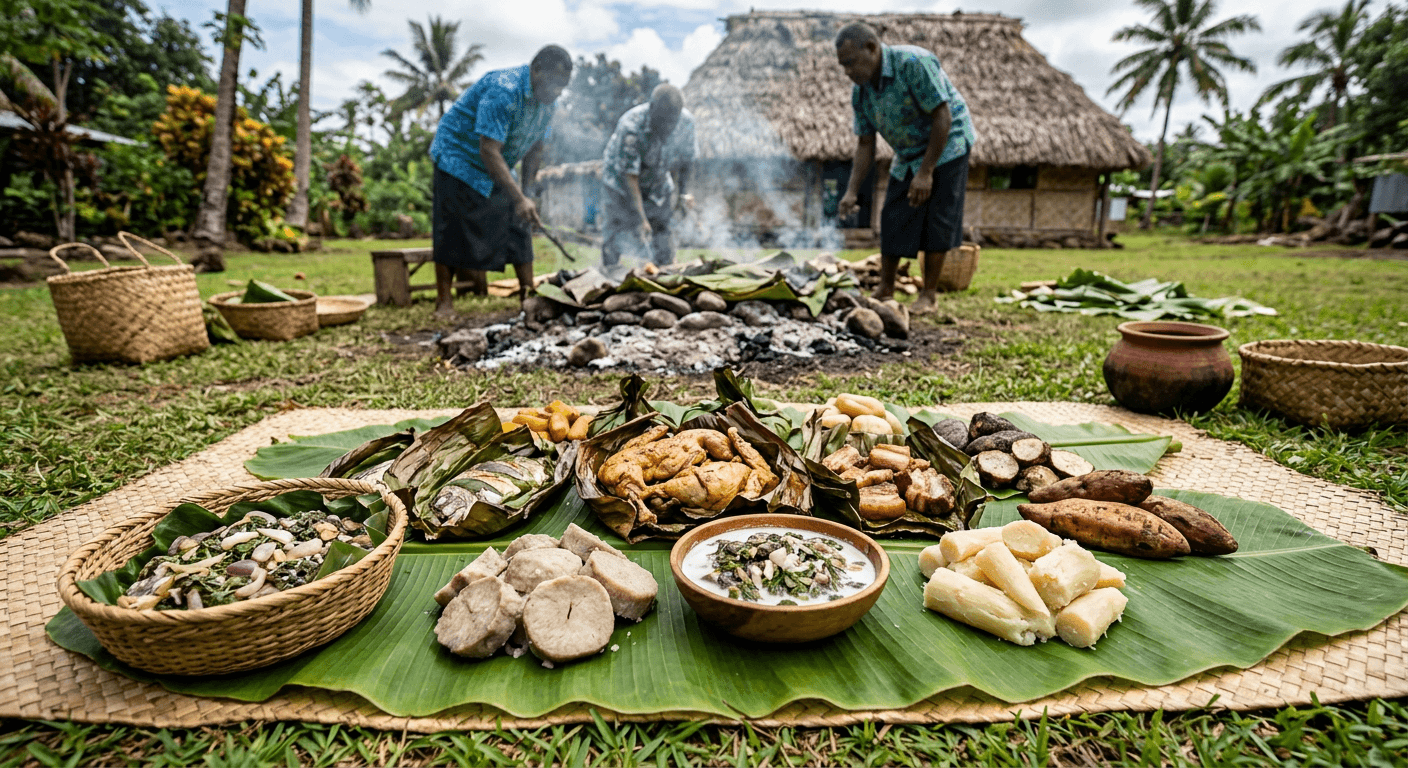

The lovo is the perfect example of why Fiji food hits different — it's not a quick recipe, it's a whole day. You put it in the ground in the morning, and hours later it comes out changed in a way no kitchen can replicate.
Arrnott Olssen
Travel & Experience The Lovo: Fiji's 7-Hour Feast
Why the best meal in Fiji starts before breakfast and ends at sunset
Most meals are measured in minutes. You prep. You cook. You eat. The lovo is measured in hours — and that difference is the entire point.
A lovo is an earth oven. It's one of the oldest cooking traditions in the Pacific, and it's still very much alive in Fiji today — at celebrations, at village gatherings, at funerals, at weddings. Anywhere that a community is coming together to mark something that matters, you might find someone already digging a hole in the ground early in the morning.
I've been at lovo feasts that I still think about years later. And I've seen people eat from a lovo for the first time and not be able to find words for what just happened to them. That's not an exaggeration.
How a lovo works
The process begins before dawn, or at first light. A pit is dug — typically around a metre deep and wide enough to hold the day's feast. Rocks are arranged inside the pit: volcanic rocks are ideal, porous enough to hold heat without cracking under the extreme temperatures that come next.
A fire is built inside the pit on top of the rocks and burned hot for two to three hours, until the rocks are thoroughly heated through — white-hot, heat-saturated, radiating in a way that you feel from several feet away. This is the heat source for everything that follows.
The food is prepared and wrapped: meats — traditionally pig, chicken, fish, or whatever is available — along with root vegetables, dalo, cassava, kumala (sweet potato), and sometimes cassava pudding wrapped in banana leaves. Everything is bundled carefully, often in banana leaves or burlap, to trap steam and protect the food from direct contact with the coals.
Then the fire is raked out, the food goes in on top of the hot rocks, and everything is covered. More banana leaves. Hessian sacks soaked in water. Earth piled on top. The whole thing is sealed.
And then you wait.
"The lovo is the perfect example of why Fiji food hits different — it's not a quick recipe, it's a whole day. You put it in the ground in the morning, and hours later it comes out changed in a way no kitchen can replicate."
What happens in those 7 hours
The waiting is not passive. A lovo day is a full social occasion. While the food cooks underground, the community gathers. Children play. Elders talk. Young men tend the covering, checking for steam escaping from weak points and packing earth back down where needed. Women prepare the rest of the feast — the coconut cream dishes, the salads, the things that will sit alongside what comes out of the ground.
The smell starts about halfway through. A low, smoky, mineral warmth that drifts across the whole gathering. By the time the six or seven hour mark arrives, everyone is attuned to it. The conversation changes. People start moving toward the pit.
The uncovering is a ceremony. The earth is moved. The sacking is pulled back. Steam rises in a rush — dense, fragrant, carrying the smell of slow-cooked pork and banana leaf and something older than either. The wrappings are removed and the food is laid out.
Everything has changed. The meats are falling-apart tender. The root vegetables are soft and slightly smoky. The flavour is unlike anything a kitchen can produce — because a kitchen isn't a pit, and a pit is the only thing that gives you this.
"My stepfather once prepared a lovo for my birthday in a friend's backyard in Australia, and friends still reference it years later as one of the most memorable meals of their lives."
Why it matters culturally
The lovo isn't just a cooking method. It's a way of organizing a community around a shared task that takes an entire day. Everyone has a role. The preparation of the pit and the fire is typically done by men. The preparation of the food is typically done by women. The children carry things, fetch water, stay close. The elders observe and advise.
By the time the food comes out of the ground, the community has been cooking together for seven hours. The meal that follows isn't just eating — it's the conclusion of a day's shared effort. That changes how the food tastes.
There's also a spiritual dimension that's present without always being spoken. The lovo in Fiji has roots that connect to ceremony, to honoring ancestors, to marking moments that deserve more than a kitchen can offer. When you eat from a lovo, you're participating in something that has been happening in this part of the world for longer than any recipe.
"The most powerful Fiji meals aren't about performance — they're about who is at the table. The people, the protocols, the respect, the way you're welcomed in. That's what makes it real."
What a tourist normally gets instead
I want to be honest about this. There are resorts in Fiji that offer a 'lovo night.' It is usually: a barbecue setup with a decorative pit nearby, some meats carved at a station, and a buffet. It is fine. It is pleasant. It is not a lovo.
A real lovo is not a dining experience. It's a day-long process that happens because a community has decided that what they're celebrating deserves it. You don't schedule a lovo and sell tickets. You arrive somewhere where one is already happening, and you're welcomed in because you're a guest, and that welcome comes with obligations on both sides.
That's the version worth finding. And finding it requires knowing someone who can bring you to it — someone who understands the protocol, who knows when to present the sevusevu (the traditional gift of kava root offered to the village chief on arrival), who knows what it means to be a guest in a Fijian home and how to hold that properly.
Getting that right isn't complicated. But it is specific. And it's the difference between watching a lovo from a bus window and being at the table when the food comes out of the ground.
"The through-line for me is simple: Fiji food isn't just food. It's identity, it's history, it's home — and if people come with me, I want them to feel that, not just photograph it."
A full-day lovo experience is one of the centrepiece moments of The Kana Journey — hosted by Arrnott, with proper village protocol and a table you genuinely won't find anywhere else.
→ View The Kana Journey at qurocollective.com